Cue normalisation in multisensory integration studies

Comparing multisensory integration across different sensory cues is tricky because the size of the multisensory benefits depends on the variance of individual cues. How can cue normalisation solve this problem?

LAB NOTEMULTISENSORY INTEGRATION

Thomas Chazelle

2/4/20264 min read

A sizable part of my postdoc in Marko Nardini’s lab at Durham University has been dedicated to investigating the stability and specificity of audiovisual integration: How does it vary from one individual to another, from one moment to the next, from one pair of cues to another, from familiar to new sensory cues?

Why you should care about cue normalisation

An important aspect of this question involves comparing multisensory benefits – for example, checking whether your ability to integrate two cues correlates with your ability to integrate two different cues. The problem is, some cues are notoriously more reliable than others, making comparisons difficult.

Simply put, some (typically visual) cues are comparatively so good that the expected benefits of adding another less reliable cue become very small. I guess this technical limitation played an important role in the success of the notion of visual dominance in the earlier literature (see also the concept of “visual capture”).

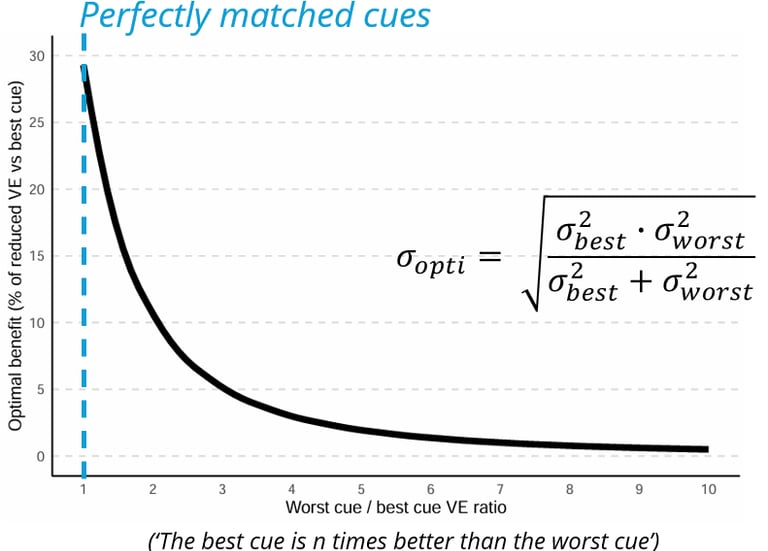
The reduction in the expected benefit stems directly from the ML equations we use to predict the optimal variance. These equations predict that cues are weighted by their reliabilities, such that the information added by a new cue should reduce the amount of variable error (say, the variance) compared to when only the best cue is available. However, as can be seen on this plot, the benefit quickly decreases as the variable error ratio between the best and worst cues increases. This has also been commented in earlier work by Marko and the brilliant Meike Scheller.

Comments

This plot shows the expected optimal benefit as a function of the mismatch between the cues. The expected benefit quickly drops when the mismatch grows, making the benefits harder to detect. The blue line shows perfectly matched cues and the maximum benefit (about 30% of variance reduction).

The collapse of the expected multisensory benefits is a big problem in at least two contexts. First, when trying to establish evidence for multisensory benefits – the benefit produced by greatly mismatched cues is so small that it would be virtually undetectable. Secondly, and of particular interest to us, it can make it tricky to compare different people’s ability to combine different types of cues. How could we look at variability in how people integrate if the theoretical benefit is so small to begin with? The cue mismatch problem could lead to both false positives and false negatives.

That’s where cue normalisation, or cue calibration, comes in. By measuring the variable error associated with each individual cue, it becomes possible to purposely make the best cue noisier or the worst cue easier, improving the match. Normalisation can be done at the participant level, tailoring the difficulty of each cue to each participant – or even during a session (heard in a talk by Benjamin Rowland at IMRF 2025).

Why you should think carefully about how you normalise

The goal of normalisation is simple in principle: tailor cue difficulty to each participant so that all cues have comparable levels of variable error, yielding worst/best cue ratios close to 1. In practice, it can be trickier than it looks.

A common approach is to first measure a unisensory discrimination threshold for each cue, and then scale the difficulty of the cue in the multisensory task. For example, in our study, we tried to match the sensory cues in a localisation task by defining the test space in numbers of thresholds. For example, our multisensory task involves learning to use colour to locate a hidden target. If a given participant has excellent colour discrimination abilities, then they would have a low discrimination threshold in the normalisation task, and the range of colours in the localisation task we would therefore be narrower than that of a participant which a higher discrimination threshold.

While piloting for our main study, we compared two different ways to establish the threshold. The first method consisted in a non-directional oddity task. Participants judged which of three stimuli differed from the other two, and the difference between the odd stimulus and the other two was determined by staircases to obtain a threshold for each cue. For example, participants would see three coloured circles with one having a slightly different shade. The task was running fine, but we found out the cues were still greatly mismatched in the multisensory task.

Reflecting on these results, we realised that the oddity task required participants to identify a difference – any difference – between the stimuli, whereas in the multisensory localisation task, they needed to order the stimuli (e.g., identify whether a sound is coming from further left or further right, as opposed to just not being the same). That’s why we tried a second method. It was similar to the first, but used only two stimuli in a directional task: it required participants to judge not only whether the stimuli were different, but how. For example, they would need to judge whether the second coloured circle was more yellow or more pink than the first. Both methods rely on thresholds to normalise the cues, but they differ in how closely the normalisation task matches the demands of the multisensory task.

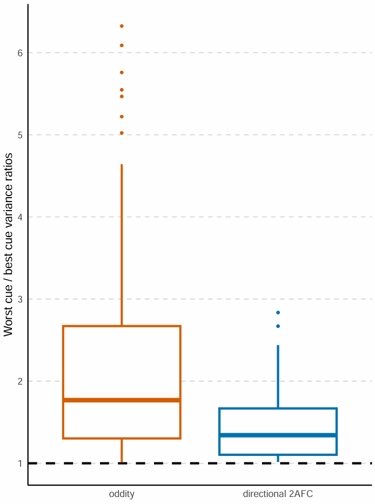
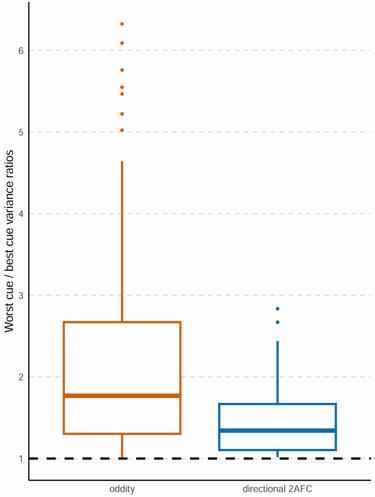
Cue ratios got significantly closer to 1 when we normalised using the directional task (1 is a perfect match).

As you can see on the plot above, this small difference turned out to matter in our case (although some of this spectacular difference is also due to making the dots slightly harder and the pitch mapping slightly easier). The worst/best cue ratios were significantly closer to 1 in the directional 2AFC task than in the oddity task. A good case study of why normalisation requires careful consideration.

Poster

We made a poster about this and our RA Sophia Hand presented it at EPS London 2026 – you can see it here, but to conclude in an utterly postmodern fashion: Normalisation is not method-neutral.